|
||||
|
|
|
|
|
| Folio | About Me | Machines | Links | Home |
|
The Machines | ||
|
Linkogram
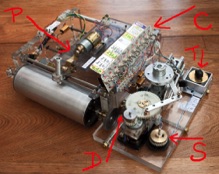
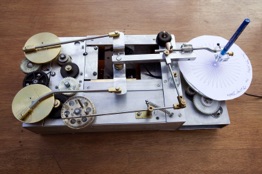
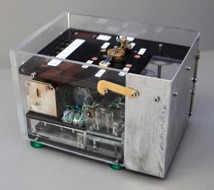
The Linkogram machine was developed to both mimic and extend the type of image which is produced by the 19C drawing machine termed a Harmonograph. This uses two pendulums, sometimes in compound form, to produce what are Lissajeus figures. It has significant limitations in that its results cannot easily be repeated and the pendulums come to rest. The Linkogram, so called because it works by means of linkages, can produce far more complexity and variety of image, whose characteristics are both controlled and repeatable. This is essential if a drawing machine is to be a design tool. The range of possible combinations is large and is extended by the addition of a turntable and pen lift mechanism. A light pen is also available; using light increases the variations. The Linkogram is 'programmed' by the ratios chosen to drive the speed of the linkages and by the exact start points of the main drive wheels; hence the clock faces as reference points (see the picture). Given accurate recording of settings and resetting, an image can be repeated to near 'registration' precision. To my knowledge this machine represents a unique solution to produce the images shown. Click to view Linkogram images | |
|
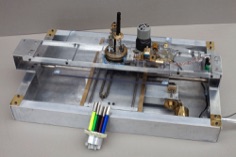
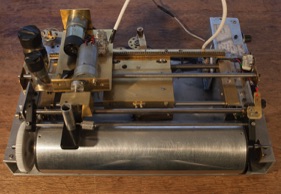
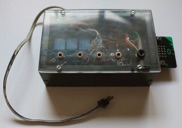
Wave Machine When I used a computer, one of the areas explored was sinewaves. This was easy with a programme and a plotter; unfortunately the computer/plotter set up, an old Hewlett Packhard machine, eventually broke down. I was curious to find out if an analogue machine could be built to produce similar images. This machine shows it is possible and it performs to a high degree of accuracy with many combinations. I have worked out a modification which will allow the wave pattern to 'break' as in the waves at sea. At present the waves grow and decay, either by an increase each line or at the crest of each wave. The line width is also controllable to fine limits. This machine is 'programmable' to some extent by altering the switches shown at the top of the picture. Again, repeatability is relatively easy. Click to view Wave Machine images | |
|
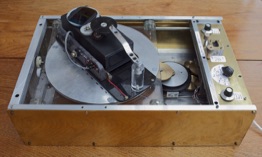
Turntable I designed this to explore circular images, which had proved productive in past machines, particularly those using light as opposed to pens. See the image over the 'About me section. In addition, I wanted to mimic the character of a rotating slit of light as a light drawing source. The slit image is planned for a future light machine. To do this I devised a bank of rotating pens as one of the actions. So, the machine has a turntable, a rotating pen set and a 'to and fro' linkage moveing the turntable. There are three motors involved, one for each movement and these can either be on at the same time, going at different speeds or switched on sequentially by a 'time' programmer. I have so far built two programmers, each with different characteristics and plan others. The sequential switching method of use has so far produced the most interesting images. See Rotor6 and others in that group. Further modifications (this is Mk2) are planned to increase the number of combinations. Click to view Turntable images | |
|
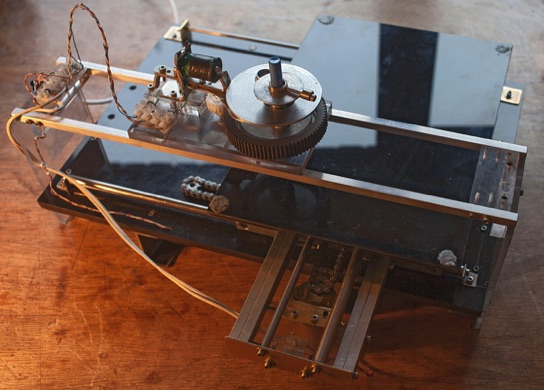
NSEW There are two machines in this group where the pen can either go North/South or East/West. One is a simple two axis movement with a reversible motor for each axis. The principle behind both machines is that the pen has the 'choice' of going in any of the four directions at any time. A time programmer is essential to both and the motors are switched sequentially. The NSEW machine is shown with the light pen unit in place which is simply clipped on in place of an ordinary pen. This, pen can also rotate so as to allow some way of visualising what the machine will draw when the light unit is in place. Click to view NSEW images | |
|
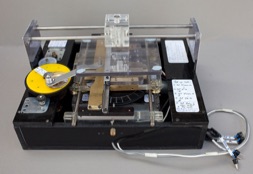
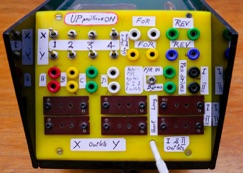
NSEW sp The second is more complex with a sun and planet mechanism on each axis; one for the paper table and another at right angles for the pen. Hence the name NSEWsp. Each sun and planet gear set is driven by two motors, making four in total. The sun and planet gears means that the final course of the main drive pin is very complex which increases the combinations. They run into many millions. The pen main drive pen is in the centre of the yellow main pen drive unit (see picture). The most complicated images occur when the top half of one axis is coupled to the lower half of the opposite axis and vice versa. This is admittedly difficult to visualise as it is an extremely involved motion and not easy to describe in words. The movie clips might help to throw some light on this action. Click to view NSEW sp images | |
|
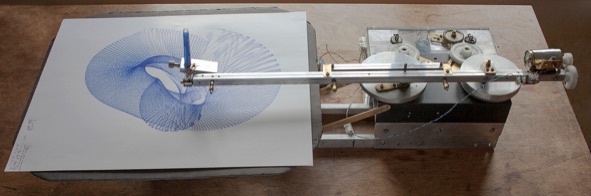
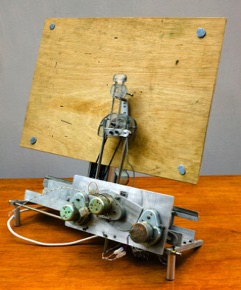
Meccanograph Years ago, a machine was described in a Meccano instruction book which drew circular images, most resembling flower petals. They were simple and the line quality was poor, owing to the amount of play in the bearings and guides. I built a few of these as a boy and remembered them when I became interested in making other machines. This early interest led to the development of my Linkogram which produced similar drawing to a harmonograph but did not rely on pendulums but on eccentrics and linkages. It went through many 'Marks' and the present one is due for a redesign to make it more versatile and accurate. Recently,inspired by other machines made in the early 20th century, the Creighton and Dechevren models, I made a machine to draw similar figures and made a 'meccanograph type' machine but built to a better engineering level than the Meccano ones. This is shown, but not used very much as I find such images to be relatively uninspiring, being simple patterns, decorative motifs and symmetrical. These image characteristics do not interest me as much as the freer drawings produced by my NSEW, Sine wave and Turntable machines. Click to view Meccanograph images | |
|
Light Box I have used a simple 'point source' light pen many times with my drawing machines. Recent light units have an illuminated slit, which can revolve as it 'writes'. See the picture with the coloured gel wedge in place. All that is done is to set up the digital camera over the machine in a darkened room and expose for around 30 seconds. Contrary to what is believed, the Canon camera produces no noise on long exposures. This pen unit makes a 'calligraphic' type of line available, which can vary in tone and colour as required. See the light images. Click to view Light Box images | |
|
Sequential Timer Programmers
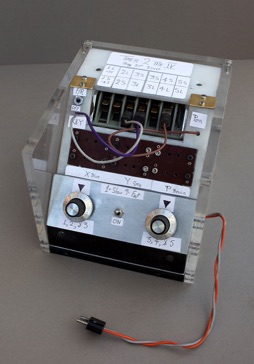
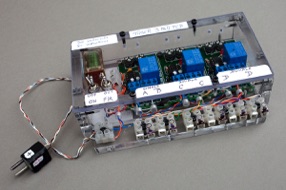
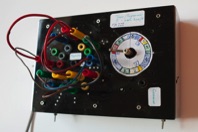
The 'brains' of the machines. Many recent machines are in the form of X Y plotters whose movements are restricted to two directions only. I have termed them NSEW (North South East West) machines as my intentions are that they will always have the chance to move the pen in any of these directions at any time in the programme sequence. These plotters have a reversible motor for each axis. Obviously these motors need instructing to start, stop and go forward or reverse. These instructions are provided by programmers which I have designed. They are a set of switches, one for each action i.e. X motor start forward, stop, Y motor start in reverse, stop and so on. There are two different programmers at present but both are driven by their own motor which activates micro switches by means of cams or rotary switches. The main d.c. power is fed into the sequential programmer which processes the instructions and governs the actions of either NSEW machine. | |
The motors are switched on for different amounts of time, which governs the length of line which the pen draws. These instructions are very simple in themselves i.e. X motor go forward for 3 seconds then stop. Clearly if the sequence of instructions is too regular and repetitive then the drawing is boring. There is a need to design strings of instructions which have variety and do not repeat too soon. In addition I want to include a quasi random element in the instructions to add richness to the drawings. This is all similar to writing a computer programme where the programme has a chance to 'throw a dice' and to branch off in different directions, according to where it is at any given time. My analogue programmers achieve something similar by using gear trains to drive different sets of switches and where the gear train for say the X axis, or North South direction is of a different ratio to that of the Y axis, or East West direction. For example if the X ratio is 1: 1 and the Y axis is 1: 1.175 then the difference is between 1 and 1 1/2 percent and it will take a long time for the two ratios to return to the same place. If a further switch is put in place, driven by yet a different ratio and operates only the auto reverse
switching for all motors, then the resulting combined output is capable of even greater complexity. Finally if there are facilities for altering the rate of switching of the auto reverse by plugging it into the X Y sequence at different places, then the richness of drawing is increased further.
In the most recent NSEW machine, the NSEWsp, I have made each axis linkage to be operated by what is called a sun and planet eccentric. This in itself offers a complex motion but if the sun part has a separate motor to that of the planet wheel then the characteristic of the motion, even in one (North South) direction, is made even more complex. The ultimate richness is obtained when the instructions are 'crossed' and the X sun and Y planet are hooked up together in one sequence and the Y sun and X planet are similarly coupled. All this must sound very complicated but it has all been worked out over a long time and is capable of extremely interesting images (see the NSEWsp set of drawings). I have calculated that the NSEWsp machine is capable of up to 37 million variations. Even if my maths is not accurate, there is a wide range of different drawings.
It is important to remember that the basic set of possible instructions i.e. X forward, X reverse, Y forward, and Y reverse is all that there is; just four alternatives. What creates the richness is the sequence and the time given to each switch. This is what is so exciting about the use of machines and simple programmers. Programmers which do just that; provide repeatability, if (and it is a big IF) the machines can always be reset to start in exactly the same place. This is a lot more difficult than might be imagined. There are a lot of variables, and the complexity of the maths is beyond my abilities. Using a modern computer would in some respects be easier than building relatively crude mechanical devices. The chief problem with using a computer is that the programmer must know in what general direction to go before the programme can be written, even given the opportunity to build in random elements. When I began making the mechanical sequencers I only had an intuitive notion that a particular arrangement might be interesting. Over the years I have found out which ratios and gears are most likely to give the best variety. Lots of notemaking and records does pay off in the long term. An added problem is the cost of plotting software and the need to be able to get a sufficiently high resolution screen dump to compare with the line quality of the analogue devices. This is not to mention the time taken to write, and correct the programmes. I am not against using computers and hope to find the right software for my G4 OSX Apple Mac system in the not too distant future. Any reader of this web site is welcome to make suggestions as I have spent a lot of time searching for the right combination but so far have been unsuccessful. | ||
| Folio | About Me | Machines | Links | Home |